
As more teams adopt AI agent builder platforms, certain mistakes appear repeatedly across projects, regardless of which specific platform is being used. Recognizing these patterns in advance helps teams avoid the frustration of a failed first project and the organizational skepticism toward agent based automation that often follows.
Mistake One: Starting With an Overly Ambitious Scope
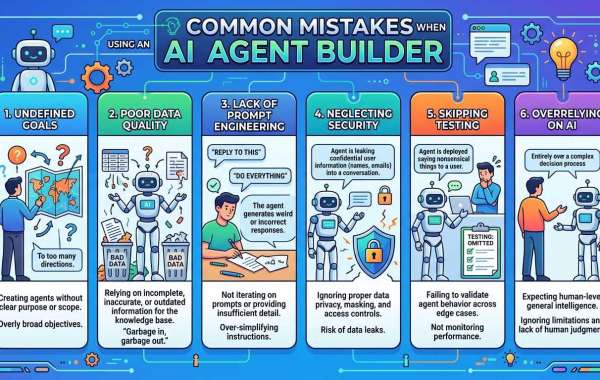
The single most common mistake teams make is attempting to build a broadly capable agent handling many different tasks or scenarios right from the start, rather than beginning with a narrow, well understood use case. An AI agent builder genuinely rewards focused scope, since a narrow task is easier to fully map, test and guard properly. Ambitious first projects frequently stall or produce unreliable results, damaging confidence in agent based automation before it has a real chance to prove its value on something manageable.
Mistake Two: Skipping Proper Process Mapping
Many teams jump straight into configuring an agent's logic within the platform interface without first thoroughly mapping how the actual process works, including exceptions and edge cases. This shortcut consistently produces agents that handle the happy path reasonably well but fail unpredictably the moment a real world input deviates from the ideal case the team had in mind while building. Proper process mapping before touching the AI agent builder interface catches these gaps far earlier and far more cheaply than discovering them after deployment.
Mistake Three: Weak or Missing Guardrails
Some teams, eager to demonstrate an agent's autonomous capability, configure minimal guardrails, allowing an agent to take consequential actions without any human review. This creates genuine risk, particularly for actions that are difficult or costly to reverse, such as sending customer communications, modifying records, or processing payments. A well configured AI agent builder project starts with conservative guardrails and relaxes them gradually as the agent demonstrates reliable performance, rather than starting permissive and hoping for the best.
Mistake Four: Testing Only With Ideal Inputs
Testing an agent exclusively with clean, expected inputs creates a dangerously false sense of readiness. Real world usage inevitably includes ambiguous requests, incomplete data, and scenarios the original process mapping did not anticipate. Teams that skip testing with messy, realistic inputs frequently discover their agent's genuine limitations only after deployment, when the cost of failure is significantly higher than it would have been during a proper testing phase.
Mistake Five: No Plan for Handling Agent Failure
Agents will inevitably encounter situations they cannot handle correctly, whether due to ambiguous instructions, an unexpected system response, or a genuinely novel scenario. Teams that fail to build a clear escalation path, a way for the agent to recognize it is stuck and hand off to a human rather than proceeding with a potentially incorrect action, end up with failures that compound rather than get caught early. A quality AI agent builder implementation always includes a defined answer to the question of what happens when the agent does not know what to do next.
Mistake Six: Treating Deployment as the Finish Line
Some teams treat successful initial deployment as the end of the project, moving on to other priorities without ongoing monitoring or iteration. Agent performance in production frequently reveals patterns and edge cases that testing did not fully anticipate, and without continued attention, small unresolved issues accumulate into larger reliability problems over time. Teams that get the most value from an AI agent builder treat deployment as the beginning of an ongoing improvement cycle, not a completed task.
Mistake Seven: Ignoring Integration Reliability
Agents depend heavily on the external tools and data sources they connect to, and teams sometimes underestimate how much an agent's reliability depends on the reliability of those underlying integrations. An otherwise well built agent can fail consistently simply because an API connection is unstable or a data source returns inconsistent formatting. Regularly monitoring integration health, not just agent logic, is essential to maintaining reliable agent performance over time.
Mistake Eight: Choosing a Platform Mismatched to Team Skill Level
Selecting an AI agent builder platform that requires more technical depth than the team actually has, or conversely, one too simplified for genuinely complex requirements, creates ongoing friction regardless of how good the underlying agent logic might theoretically be. Matching platform complexity honestly to team capability, rather than choosing based on feature lists alone, prevents this avoidable mismatch from undermining an otherwise well planned project.
Final Thought
Most failures involving an AI agent builder trace back to a small set of recurring mistakes: overly broad initial scope, insufficient process mapping, weak guardrails, inadequate testing, and treating deployment as a finish line rather than an ongoing process. Teams that deliberately avoid these patterns, starting narrow and building outward based on real performance data, consistently get more reliable, trustworthy results from their agent projects than teams that rush toward ambitious autonomy too quickly.