
Wellness claims often travel faster than the research behind them, and NAD+ therapy is a clear example. The molecule is genuinely important in human biology, but the gap between what is established and what is marketed is substantial. This article examines the science underpinning an NAD+ IV Drip in Dubai, separating well-documented biology from preliminary findings and speculative claims. The purpose is not to dismiss the treatment, but to help you evaluate it with appropriate scientific scepticism rather than accepting confident assertions at face value.
NAD+ as a Fundamental Molecule
NAD+ is not a novel or exotic substance. It is a coenzyme present in every cell, and it has been studied for over a century.
Its established roles include:
Serving as a cofactor in redox reactions central to metabolism
Participating in glycolysis and the citric acid cycle
Acting as a substrate for enzymes involved in DNA repair
Supporting cellular responses to stress
Without NAD+, cells cannot generate energy efficiently or maintain genomic integrity. This much is not controversial and forms the bedrock of interest in the molecule.
NAD+ IV Drip in Dubai: The Age-Related Decline
A consistent finding across studies is that NAD+ levels decline with age in various tissues. This observation has driven much of the interest in replenishment strategies.
Factors associated with lower NAD+ levels include:
Increasing age
Chronic inflammatory states
Metabolic stress
Certain disease conditions
Lifestyle variables such as diet and activity
What remains debated is the clinical significance of this decline. A biomarker changing with age does not automatically mean that reversing it produces health benefits. That inference requires interventional evidence, which is still developing.
What Research Has Investigated
Scientific interest in NAD+ has focused on several areas, including:
Cellular energy metabolism
Age-related physiological changes
Neurodegenerative processes
Metabolic function
Muscle and cardiac function
Much of this work has been conducted in laboratory models and animal studies. Human trials exist but are fewer, often small, and frequently use oral precursors rather than intravenous NAD+ itself. Extrapolating from these to IV infusion in healthy adults involves assumptions that should be stated openly.
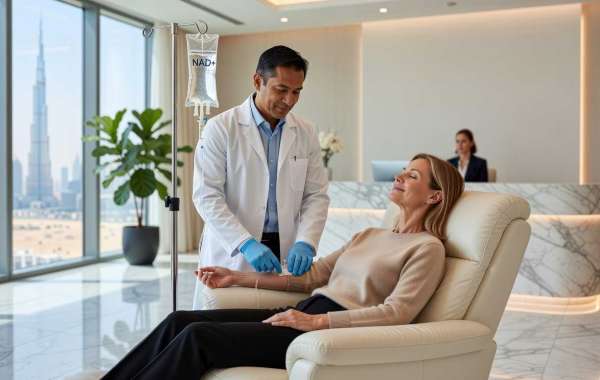
NAD+ IV Drip in Dubai: The Intravenous Route
Oral NAD+ faces significant breakdown in the digestive tract, which is the rationale for intravenous delivery. Infusing the compound bypasses this obstacle and raises circulating levels more directly.
However, raising blood levels is not the same as achieving a clinical effect. Several questions remain:
How much infused NAD+ enters target tissues?
Does cellular uptake translate into functional change?
Are any effects sustained or transient?
Do outcomes differ between healthy and unwell individuals?
These are legitimate scientific questions rather than objections. They indicate that the field is active but not settled.
Distinguishing Mechanism From Outcome
A common error in wellness marketing is treating a plausible mechanism as proof of benefit. The logic runs: NAD+ is involved in energy production, therefore infusing it increases energy.
This reasoning skips several steps. Biological systems are complex, and interventions that alter a pathway do not always produce the expected functional result. Responsible communication acknowledges this gap rather than collapsing it.
NAD+ IV Drip in Dubai: The Role of Precursors
Much of the human research on raising NAD+ levels has used precursors such as nicotinamide riboside or nicotinamide mononucleotide, taken orally.
Points worth noting:
These are different compounds from infused NAD+
Their absorption and metabolism differ
Findings from precursor studies do not automatically apply to IV NAD+
Comparisons between the two are often conflated in marketing
Understanding this distinction helps you assess claims that cite research which may not actually relate to the treatment being offered.
What Cannot Currently Be Claimed
Given the present evidence base, several claims are not supportable:
That NAD+ infusion treats or prevents any specific disease
That it reliably improves energy in all recipients
That it slows or reverses ageing in humans
That benefits are permanent
That it is superior to other approaches for any defined outcome
Clinicians acting responsibly will avoid these claims, even where patient demand might make them tempting.
Where Scientific Uncertainty Leaves Patients
Uncertainty is not the same as futility. It means the evidence is incomplete, and decisions must be made with that limitation in mind.
Practical implications:
Treat reported benefits as plausible but unproven
Expect variability in response
Be cautious of confident claims in either direction
Ask what evidence supports a specific statement
Recognise that absence of proof is not proof of absence
Holding this balance is more useful than adopting either extreme position.
How Clinicians Should Communicate the Evidence
In our clinical experience, patients respond well to honest descriptions of uncertainty. Overstating the science tends to erode trust once expectations are not met.
At Tajmeels Clinic in Dubai, discussions about treatment include what is established, what is preliminary, and what remains speculative, so patients can weigh the decision with accurate information.
Conclusion
NAD+ is a biologically essential molecule with well-documented roles in metabolism and cellular repair, and its levels do decline with age. What remains unproven is whether intravenous replenishment produces reliable clinical benefits in healthy adults. Understanding that distinction protects you from both unwarranted scepticism and unwarranted enthusiasm. If you are considering treatment, ask what evidence supports the specific claims being made. Tajmeels Clinic in Dubai can discuss the current science, including its limits, as part of an individual assessment
Book Your Liposuction Consultation at Tajmeels Clinic
Considering liposuction in Dubai? Book your consultation at Tajmeels Clinic to discuss your goals, treatment options, expected results, and recovery with our medical team. Contact us today to learn whether liposuction is suitable for you and receive an individualized treatment plan.
WhatsApp: +971 56 203 8751
Phone: +971 4 373 9000
Social Media: