
200 Hour Yoga Teacher Training in Rishikesh: How Much of the Course Is Theory vs Practice?
Think of the best teacher you ever had.
Maybe you don’t remember them just because they gave you good grades or told you to read the right books. You remember when something hard suddenly became clear. They explained it, showed you how it worked, let you try, corrected you, gave you enough time to understand it for yourself.
That’s how a great school of yoga should be.
So when you start researching a 200 hour yoga teacher training in Rishikesh it’s normal to ask yourself: How much time will I be practising, and how much time will I be sitting in a classroom learning theory?
The honest answer is that good training can’t draw a neat line between the two.
Table of Contents
What does theory actually mean in yoga teacher training
The word “theory” can be a bit intimidating.
You might picture long lectures, confusing jargon and pages of information to memorise. But a meaningful theory isn’t supposed to feel like studying for an exam.
The theory in a 200 hour yoga teacher training in India gives you the understanding behind what you are practising.
For example, when you study anatomy, you will know what is going on in the body during different movements. You study yoga philosophy to learn about the ideas and traditions behind the practice. When you learn about Pranayama, you understand principles of breathing, not just copy a breathing technique.
These lessons provide context for your practice.
Without theory, we can know what we are doing without really understanding why.
And that “why” becomes particularly important when you eventually guide somebody else.
But can yoga really be learned from books?
Not altogether.
You can read about meditation without knowing the experience of sitting quietly with your own mind. You can learn the principles of alignment without feeling what a position feels like in your body. You can learn about pranayama without knowing how your breath changes when you practice it.
This is where practical learning becomes relevant.
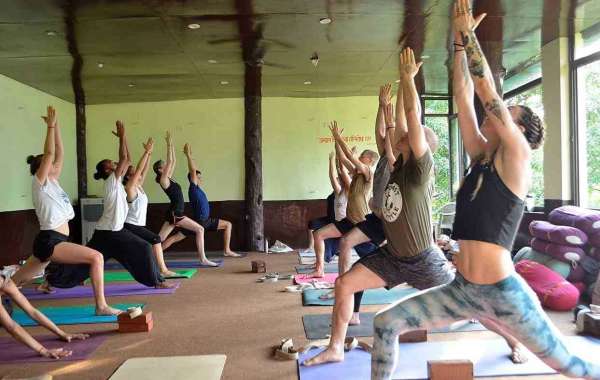
A 200 hour yoga teacher training in Rishikesh should give you the opportunity to experience what you are learning.
You learn an asana, and then you practice it.
You learn alignment; you observe alignment.
You study sequencing, and then you create one.
You learn teaching methodology, and then you stand in front of your classmates and teach.
The experience gives the information somewhere to settle.
Practice is not just doing yoga all day
When people hear “practical training” they tend to think of hours of physical asana practice.
Asana is definitely an important part of practical learning, but practice goes way beyond.
You can practice pranayama and meditation. You may see demonstrations. You could work on sequencing. You can practice giving instructions and learn how to communicate a posture clearly.
You can also learn by observing other students.
Someone might teach a sequence differently than you would. You get to see what works, what could be clearer and how students react. And then you bring that observation back into your own practice.
This is why a strong 200 hour yoga teacher training in India does not see the practical sessions as a break from “real learning.”
Education is the practice.
The most useful lessons happen between theory and practice
Suppose in the morning you learn a certain alignment principle.
And then you can try out the pose yourself later.
You see something in your own body, that you did not get from the explanation only. You ask your teacher. They demonstrate another variant. Suddenly, something that sounded abstract in the classroom makes sense.
That’s the kind of relationship a good course should build.
Theory gives you a grounding.
That’s what you get from practice.
It helps you to understand it through reflection.
Then you go back to practice with a bit more awareness.
This cycle is what turns a 200 hour yoga teacher training in Rishikesh into more than just a bunch of classes.
What should your 200 hours ultimately give you?
By the end of the course, you should have in your notebook not merely a lot of information.
You should have done enough of the practice that the theory begins to feel familiar in your own body and mind.
You should be able to explain why you teach something, not just repeat that you were told to teach it.
You should be practiced enough to know that teaching yoga is not about doing perfect poses in front of people. It’s about knowing what you’re selling and communicating it responsibly.
That’s the connection we love at Nirvana Yoga School.
We believe that our 200 hour yoga teacher training in India is rooted in knowledge that transitions from knowing to experiencing. You learn the principles. You practice them. You ask questions. You get guidance. And you go back to the practice with a deeper understanding.
It is not expected that you come knowing everything.