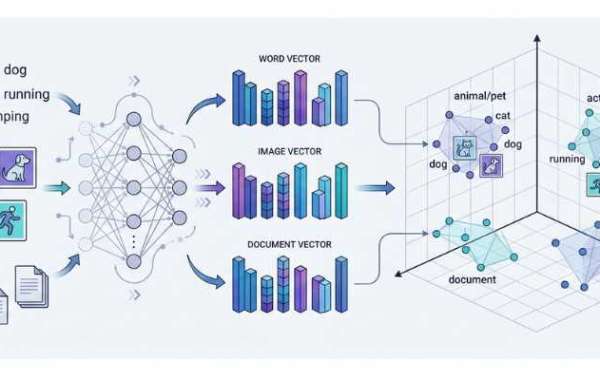

Deep learning helps computers recognize patterns, understand information, and make predictions. However, computers cannot directly understand words, images, or sounds in the same way humans do. They need a numerical way to process this information. This is where embeddings become important. Embeddings convert complex data into numerical representations that deep learning models can process. If you want to understand how modern AI systems work, explore a Generative AI Course in Trichy at FITA Academy to build your knowledge of embeddings and other essential AI concepts.
What Are Embeddings in Deep Learning?
Embeddings are numerical representations of data in a continuous mathematical space. They convert information such as words, images, audio, and other data types into lists of numbers called vectors.
These vectors capture useful patterns and relationships within the data. For example, words with similar meanings often have similar numerical representations. This helps a model identify relationships between concepts instead of treating every word as a completely separate item.
Embeddings also reduce the need to represent every piece of information using a large, complex structure. As a result, they help deep learning models process data more efficiently.
How Do Embeddings Work?
Embeddings are usually created by neural networks during training. The model learns numerical representations by identifying patterns and relationships in the training data.
For example, a language model may learn that the words "doctor" and "nurse" are related because they often appear in similar contexts. Their embeddings can capture some of these similarities.
Each embedding contains multiple numerical values. Together, these values represent meaningful features of the original data. The model adjusts these values during training to improve its ability to complete tasks such as classification, prediction, and language understanding.
The resulting vectors can then be compared using mathematical methods to estimate how closely two pieces of data are related.
Why Are Embeddings Important in Deep Learning?
Embeddings help deep learning models work with complex information in a structured numerical format. They are especially useful when a system needs to compare data, identify similarities, or discover hidden relationships. For example, a recommendation system can leverage embeddings to link users with products that align with their preferences. A search engine can compare the embeddings of a query and a document to find relevant results.
Embeddings are also essential in natural language processing, image recognition, and generative AI. They help models represent information in ways that support learning and improve performance across different tasks.
Types of Embeddings Used in AI
Different applications use different types of embeddings based on the information being processed.
Word embeddings represent individual words as numerical vectors. They help language models identify relationships between words and their meanings.
Sentence embeddings represent complete sentences or short passages. They are useful for semantic search, text comparison, and document retrieval.
Image embeddings represent visual information as numerical vectors. They help AI systems compare images, recognize objects, and connect images with text.
Multimodal embeddings represent information from different data types within compatible spaces. They allow AI systems to connect related text, images, and other forms of information.
Understanding these types helps explain how AI systems process different kinds of data and identify relationships across them.
Embeddings and Their Role in Generative AI
Embeddings play an important role in generative AI systems, including large language models. Text is commonly divided into smaller units called tokens, which are converted into numerical representations before further processing.
These representations help models identify patterns in language and use contextual information to generate responses. Embeddings also support retrieval-augmented generation, where relevant information is retrieved from a collection of documents to provide additional context for an AI model.
For example, a question-answering system can compare a user's question with stored document embeddings to find information that matches the question's meaning. If you want to strengthen your understanding of neural networks, machine learning, and related concepts, consider joining an Artificial Intelligence Course in Trichy to develop a stronger foundation in AI technologies.
Challenges and Limitations of Embeddings
Although embeddings are powerful, they have some limitations. Their quality depends on the training data and the methods used to create them. If the dataset used for training includes biases, those biases could manifest in the resulting representations.
Embeddings may also fail to capture subtle meanings, cultural differences, or changes in context. For example, the same word can have different meanings depending on how it is used in a sentence.
Choosing the right embedding model and evaluating its performance are important steps in building reliable AI applications.
Embeddings provide a practical way for deep learning models to represent words, images, and other forms of information as numerical vectors. They help AI systems identify similarities, understand relationships, and process complex data efficiently. From search engines to generative AI applications, embeddings are a fundamental part of modern artificial intelligence. Understanding how they work provides a valuable starting point for exploring more advanced AI concepts.
Also check: Gen AI in Digital Innovation Transforming Content Operations